Rohan Week 11: Political Power Across America
Unlike almost every democracy in the world, not every voting American has the same amount of political power. For a nation that is sometimes referred to as the “birthplace of democracy,” it is interesting to note that the United States is one of the only nations in the world to adopt a system similar to the electoral college.
The electoral college, in essence, makes national elections a winner-takes-all election in each state. Rather than following the popular vote, candidates that win a national election in America must win the majority of states’ electoral votes. In every state in the nation, if a candidate wins by even one vote in the state, they win all the electoral votes in the state. This makes it so that people in some states have more political power than others, in national politics at least.
Upon researching, I found a blog from WalletHub that attempts to rank the political power of voters from each individual state. Not surprisingly, the voters living in states with smaller populations had more political power. Because each state gets two Senators regardless of population, the smaller the state, the more power each individual has in choosing their Senator. According to WalletHub’s rankings, voters in Wyoming were the most powerful—a whopping five hundred times more powerful than the least powerful voters in the United States (Arizona voters).
So, why is this important? The most obvious impact of this disparity in political power is that states where voters have more political power (typically swing states) typically get more exposure to presidential candidates and campaign efforts during presidential elections. Additionally, presidential candidates often craft their platforms to be favorable to voters from swing states to gain as many votes as possible in these uber-important states. The result is a voter in California or Florida (both of which are typically not considered swing states) not feeling heard. Because a politician does not rely on their vote due to the electoral college, they do not spend energy creating policies that impact the residents of that state.
While the electoral college may have been the best type of political system for a new—and small—democracy in the late 1700s, there are questions if it is the best way to conduct our elections today. There are compelling arguments from those on both sides of the issue: maybe some voters do actually deserve more political power than others due to geographic and political factors. Or maybe America is not truly a democracy if each citizen has only the power of one vote, no more, no less.
No matter what shape this debate takes in the future, the actions of every single voting-eligible American will undoubtedly play an important role—regardless of true political power.
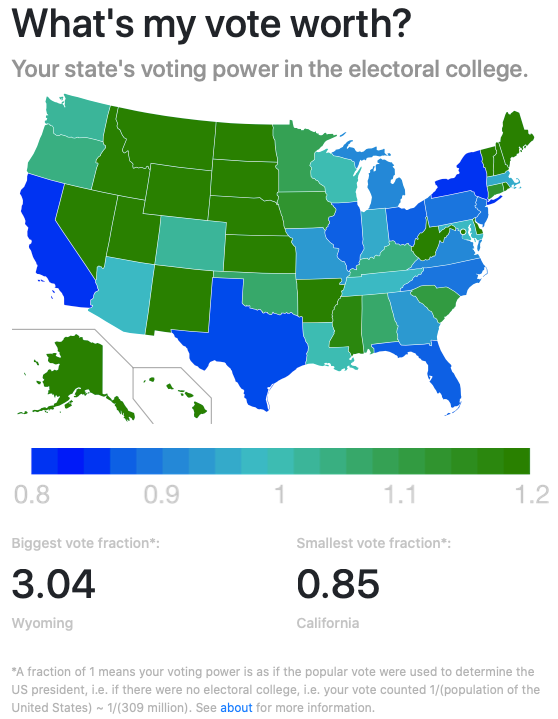
The power of a vote in each state in America (source)



Hi Rohan! I enjoyed reading your analysis of how America’s electoral college affects the amount of voting power one person has depending on the state they live in. As a California citizen, I have been aware of the issue with disproportionate levels of representation for each state, and this is something that was definitely on my mind while pre-registering to vote a few weeks ago. However, I realize that I have an excessively pessimistic view on the topic of voting—as you said, politicians focus the large majority of their attention on the swing states because they are aware that the other states are almost guaranteed to stick to the predicted side of the election, so as an individual voter in a high-population state that nearly always votes Democrat, I believe my vote makes basically no difference in national elections. Despite this pessimism, I do realize the importance of my vote to maintaining a healthy and representative democracy in America. This realization was, in part, inspired by the message you conveyed in the conclusion of this blog post—you asserted that every vote will “undoubtedly play an important role” regardless of the political situation in a given state. Due to how well-researched it is, this blog has been a valuable tool to help reflect on the implications of America’s electoral system, and it leaves me with lasting questions regarding the future of American democracy—should the system of an electoral college remain or should the country switch to functioning as a direct democracy?
ReplyDeleteHi Rohan! It was interesting to read your exploration of the electoral voting process for presidents in the United States. You vividly lay out how the process functions and its impact on our sense of democracy, ending without a stance on the subject to invite open discussion. I appreciate this as the voting system in the US is a complex issue. I believe that the nation is unique in how much it emphasizes the autonomy and power of its states. Even then, the structure of its branches indicates the attempt to compromise the emphasis on states with democracy. For instance, the bicameral legislature consists of the House of Representatives (where the state's representation is proportional to its population) and the Senate (where each state has equal representation). Of course, the fact that the electoral college system functions more like the Senate opens the question of why the process in which the president is determined does not resemble the House of Representatives. You also mentioned an interesting point about whether each American should have singular, equal votes. This raises concerns about the qualifications and education of each voter. In addition, the influence of celebrities and social media could also be utilized to skew the results of presidential races. However, the benefits are also tremendous, allowing the citizens to have a sense of ownership and participation in deciding the nation’s leaders. Overall, the issue of our voting system is nuanced and multifaceted.
ReplyDeleteHi Rohan,
ReplyDeleteYour blog was extremely informative about how the electoral college system works in presidential elections, and even raises the question about the political power that voters actually hold. After reading your blog, I better understood the difference between popular voting and the electoral college voting system, and how the electoral college system might be unfair to individual voters looking to use their vote to voice their opinions. The swing states and states with smaller populations as you mentioned hold a majority of the political power, and the fact that the campaigns of presidential candidates mainly focus on these swing states while largely ignoring the states they know they will already win just further indicates which states hold less political power. For example, California will most likely vote democrat meaning that most of the votes voting against democrats will mean nothing in the electoral college system. I realize now that this can make any voters seem useless as no matter what they do, their state is already guaranteed to vote for a party, whether that be democrats or republicans. The presidential candidates will not focus on these states, making voters feel underrepresented and unrecognized in politics, and I understand now why many voters might feel discouraged to vote because even though it's taught that one vote could make a difference, in a state like California, one vote might not actually make a difference as it is already guaranteed what party it will follow. Recently at school, almost all of us were pre-registering to vote, and I realize now that aligning myself with a specific party might have limited value because of the electoral college system. As you mentioned, this system might have been good when it was difficult to count popular votes, but now, it is more feasible to do so. I really appreciate that your blog covers the main issues in presidential voting, and especially during a critical time with presidential elections taking place this year.
Hello Rohan! This blog brings up a facinating point: just how useful is our vote and how does it make a difference on the bigger scale of where we live and we make up to be. I believe that every vote matters but as you metioned, it depends on the state in which the citizen is living in. A smaller state would mean that your vote would have a greater impact. For example, voting in Rhode Island would mean a significant change than voting in California. As a citizne of California, I do not feel discouraged. On the contrary, I like having a larger population as it means a larger economy and in general a happier lifestyle. Also, a larger population does mean a larger power on the popular vote as the ieda is to equalize the growing population with smaller states in the United States. Though not working in all circumstances, this statue does work in many situations making it a viable source of option for now. As the 2024 Presidential Election comes up, it becomes more and more important to understand our values and our role in this major task up ahead. Great work!
ReplyDelete